Appearance
Wave fusion
This module allows you to add secondary waveform to the main waveform, and combine them using various fusion methods. This can create complex and interesting sounds by blending or modulating the two waveforms together.
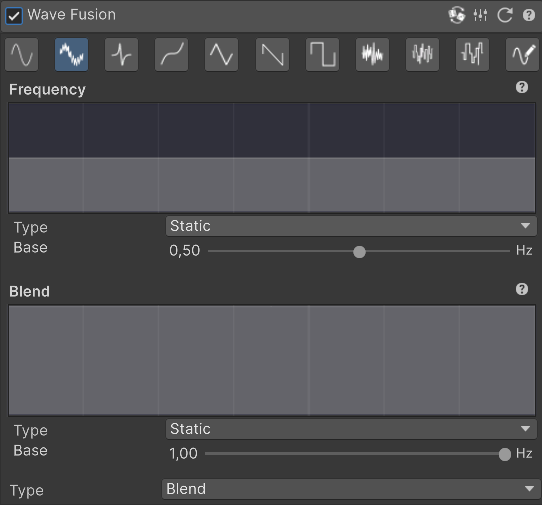
Parameters
- Waveform: The waveform shape used for secondary wave. It will be blended with the main waveform using the selected fusion type.
- Frequency: The frequency of the secondary waveform in Hertz (Hz). This determines how fast the secondary waveform oscillates.
- Blend: The amount of the wave fusion effect applied to the main waveform. A value of 0 means no effect (only main waveform), while a value of 1 means full effect (only fused waveform). This is the wet/dry mix control for the wave fusion effect.
- Type: The method used to combine the main waveform and the secondary waveform.
Blend types
- Blend: A simple average of the two waveforms.
- Top: Takes the maximum amplitude between the two waveforms at each sample point.
- Bottom: Takes the minimum amplitude between the two waveforms at each sample point.
- Whirl: Swaps the amplitudes of the two waveforms based on their sign. If the main waveform is negative, it takes the maximum; if positive, it takes the minimum.
- Mul: Multiplies the amplitudes of the two waveforms together, creating a modulation effect.
- BitMix: Combines the two waveforms using a bitwise XOR operation on their integer representations, resulting in a unique blended sound.
- Crossfade: Gradually transitions between the two waveforms based on the amplitude of the secondary waveform.
Example usage
- You can Blend secondary waveform with very low frequency to artifically add bass sound to your original sound.
- Use Blend modes to make a simple mix of two waveforms without needing to use SFXMixedTrack.
- Use Triangle Wave with Top mode to make a demon, creature or horn sound.
- Use Noise Wave with Blend or Crossfade to add texture to your sound effects, useful for explosions, impacts, and other dynamic sounds.
INFO
Wave fusion, especially with modulation types like Mul and BitMix are not commonly used in traditional sound design. It is not really a musical effect. It is more like an shaking machine that produces unexpected results. Definitely experiment with different settings to discover unique sounds that can add character to your effects.