Appearance
Tremolo
Tremolo module adds periodic modulation to the amplitude (volume) of the sound, creating a wobbling effect. This effect is commonly used in musical instruments and sound effects to add expressiveness and variation to the sound.
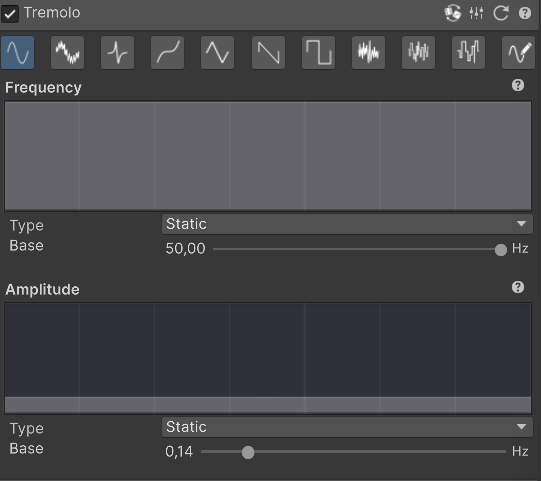
Parameters
- Waveform: The waveform shape used for the tremolo effect. Options include Sine, Square, Triangle, Saw, and Noise. Different waveforms produce different tonal characteristics in the tremolo effect.
- Frequency: The speed of the tremolo effect in Hertz (Hz). This determines how fast the volume oscillates.
- Amplitude: The intensity of the tremolo effect as a percentage of the current amplitude. This determines how much the volume varies.
Example usage
- Very low Frequency can add a movement or "unevenness" to the sound, making it feel more organic.
- Use low Amplitude values for subtle, gentle tremolo effects that enrich the sound without overpowering it.
- High Amplitude values with sharp waveforms (like Square) can create phone tonal ringing or electronic beeping effects.
- Tremolo works very well with explosions and impacts, adding "crackling" or "rumbling" effects to them, especially with low Amplitude and high Frequency values.
- Low Frequency and high Amplitude can create a "stuttering" effect, useful for simulating mechanical sounds, magical curses or otherworldly phenomena.
- Frequency that ramps up can be useful to create magical effects or machine sounds that "come to life".
- A noise Waveform with low (a 5-10hz) Frequency and medium Amplitude can create truck engine rumble or similar effects. Even lower frequencies can be used to create a marching sounds or a magical curse effect.
- Sine Waveform combined with Tremolo Noise waveform can create an effect similar to using morse-code in communications.